Printable nonograms: how to get any puzzle onto paper
Every nonogram on this site can become a printed sheet, and so can any grid you make up yourself. The solver has a PDF export built into it, and it does not require you to solve anything first — valid clues are enough.
What the export actually produces
Open the nonogram solver, type the row clues and column clues into the two boxes, and use the print option. What comes back is a PDF with the clue numbers laid out around an empty grid — the row clues down the left, the column clues stacked above each column, ready to solve in pencil.
Two details make it usable rather than merely correct. Every fifth line is drawn heavier than the rest, matching the group dividers on the on-screen board, which is the difference between counting to eleven along a printed row and losing your place at seven. And the cell size adapts between ten and twenty-two points depending on the grid, so a 5×5 does not come out as a postage stamp and a 20×20 still fits inside the page margins.
The answer key is optional and lives on a second page rather than the first, so a sheet is safe to hand to somebody without spoiling it. It appears only when the puzzle has been solved and confirmed to have a single solution, which means a printed answer key is never a guess — if the grid the clues describe were ambiguous, there would be nothing to print.
Printing a puzzle from this site
Every catalog puzzle page shows its clues before you play, which is what makes this possible: the numbers on the page are the whole prompt. Open a puzzle, read its row and column clues off the board, type them into the solver and export. It is a copy step rather than a button, but it works for all 162 catalog boards and for the daily puzzle too.
Clue entry is one line per row or column, numbers separated by spaces. An empty line means a line with nothing in it, which comes up more often than people expect on the larger boards — a 20×20 with a subject that does not reach the edges will have several. The solver tells you if the number of lines does not match the grid, which catches most typing mistakes before they become a wasted sheet of paper.
If you want a grid nobody has solved before, skip the catalog entirely and invent the clues yourself. The solver will tell you whether what you typed has one solution, several, or none at all — and only the first of those is worth printing. That check is the useful part: an ambiguous puzzle looks perfectly reasonable on paper and turns into a dead end forty minutes in.
Solving on paper is a different discipline
The screen version quietly does two things for you. It remembers which cells you have ruled out, and it lets you undo. Paper does neither, and the consequences are worth planning for before you start rather than discovering at the halfway point.
Marking empty cells stops being optional. On screen it is possible to muddle through a 10×10 by only filling squares in, because the interface keeps the blanks visually distinct. On paper an unmarked cell means "I have not looked at this yet" and a cell you have proven empty means something else entirely — and if you do not distinguish them with a small dot or cross, you will re-derive the same deduction four times. On a 15×15 that is the difference between twenty minutes and an hour.
Pencil, not pen, and press lightly. Not because you should guess — every puzzle here is solvable without it — but because a misread clue early on propagates, and the fix is easier when the wrong cells lift off cleanly. Experienced paper solvers tend to use a dot for "proven empty" and a full shade for "filled", keeping the cross for a cell they are less sure about and want to revisit.
Which sizes print well
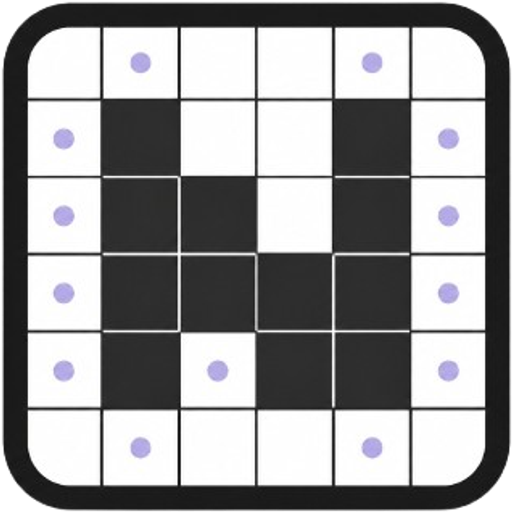
The 5×5 letters are the obvious thing to print for a child or a classroom: twenty-five cells, a recognisable glyph at the end, and a solve that takes a couple of minutes rather than an evening. Thirty-five of them exist, one per letter A to Z and one per digit 1 to 9, and every one is rated easy — the only easy-rated puzzles on the site. Printed several to a page they make a reasonable alphabet worksheet.
For an adult solving at a table, 15×15 is the size that rewards paper most. It is big enough that the overlap rule alone will not finish it, so the board stays interesting for the full twenty to forty minutes, but small enough that the printed grid stays comfortably readable at a sensible cell size. Seventy-seven of the catalog's boards fall at this size, which is nearly half of everything here.
A 20×20 prints fine but demands more from the paper. Four hundred cells at a readable size fills a page, the clue columns above the grid get tall, and you will want a hard surface and good light. It is worth doing — a large nonogram solved on paper over an evening is a genuinely different experience from the same board on a phone — but start with a 15×15 to see how your marking system holds up before committing a whole sheet to one.
Frequently asked questions
Do I have to solve a puzzle before printing it?
No. The export only needs valid clues, so you can type in a grid and print it blank. Solving first is required only if you also want the answer key page.
Can I print the puzzles from the catalog?
Yes. Each puzzle page shows its row and column clues, so you can copy those into the solver and export the sheet from there.
Are the printable nonograms free?
Yes, all of them, with no account needed. The PDF is generated in your browser rather than on a server, so nothing is sent anywhere.
What size grid prints best on one page?
10×10 and 15×15 are the most comfortable. 5×5 is ideal for children, and 20×20 fits but fills the page — the export scales the cells so any of them stay within the margins.