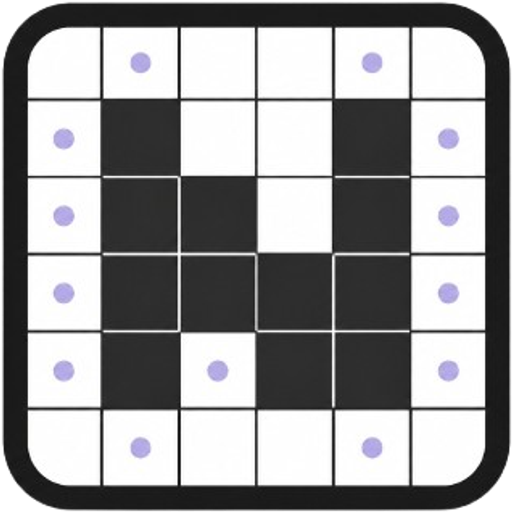
Alchemical symbols and what they mean
Antimony, brimstone, the four elements, the seven planetary metals. These marks were a working notation for three centuries before they became decoration — and they translate onto a puzzle grid better than almost anything else.
A notation, not an aesthetic
It is easy to read alchemical glyphs as mystical ornament, but that is backwards. They were shorthand, invented for the same reason chemists later invented H₂O: a practitioner writing up a procedure needed to name a substance quickly and unambiguously, in a margin, by hand, with a quill. The symbols had to be fast to draw and impossible to confuse with each other.
That constraint is why they look the way they do. Almost every one is built from a small vocabulary of primitives — a circle, a crescent, a triangle, a cross, a horizontal bar — combined in ways that stay distinct at small size. There was never a universal standard, and different workshops used variants, but the core set was stable enough that a seventeenth-century reader could follow a recipe written by someone they had never met.
The four elements
The elemental symbols are the most economical design in the whole system: four triangles, distinguished by orientation and a single bar. Fire is a triangle pointing up. Water is the same triangle inverted. Air is the upward triangle with a horizontal bar through it, and Earth is the inverted triangle with the same bar. Two decisions — which way up, bar or no bar — encode all four.
The logic behind the pairing was Aristotelian. Fire and Air were the light elements that rise, so their triangles point upward; Water and Earth were heavy and sink, so theirs point down. The bar marks the pair that were considered less pure or more mixed. Whatever one makes of the underlying physics, the encoding is genuinely elegant, and it is the sort of thing that survives being rendered in squares.
All four appear in the catalog, and they make a surprisingly good study set for a different reason: despite sharing a construction, they do not share a difficulty. Earth is rated hard at 15×15 while Fire and Water are normal at the same size, and Air — the 20×20 — is hard too. The bar is what does it. A horizontal stroke across a triangle cuts each affected row into two short runs, and short runs are exactly what the overlap rule cannot resolve.
The planetary metals
The other backbone of the notation is the correspondence between seven metals and seven celestial bodies, which alchemists treated as two aspects of one thing rather than as a metaphor. Gold went with the Sun, silver with the Moon, copper with Venus, iron with Mars, tin with Jupiter, lead with Saturn, and quicksilver with Mercury — which is why the metal is still called mercury today, the only one of the seven whose planetary name won.
The glyphs follow from that. Silver is simply a crescent moon, the most direct sign in the system. Mercury is Venus's circle-and-cross with a crescent added on top, marking it as the metal that behaves like a liquid. Jupiter and Saturn are more abstract — a stylised numeral four and a scythe-like stroke respectively — and are the two that look least like anything, which is a fair reflection of tin and lead being the least glamorous members of the set.
Four of them are in the catalog: Mercury at 10×10, which is the gentlest way into this theme, along with Jupiter, Saturn and Silver Luna Moon at 15×15. Silver Luna Moon is the one rated hard, and the reason is the crescent — a curve that closes on itself, which on a grid becomes a staircase of ones and twos with no long run anywhere to anchor a first deduction.
Antimony, sulphur and brimstone
Beyond the elements and the metals sits a long tail of substances, and three of them turn up often enough to be worth knowing. Antimony is a circle with a cross above it — the same construction as the modern symbol for the male sex, which is not a coincidence but a shared inheritance from the same set of marks. Alchemists were interested in antimony because it was used to purify gold, and it carries more mythology than its chemistry deserves.
Sulphur, the brimstone of older texts, is a triangle sitting on a cross. It mattered because sulphur, mercury and salt were held to be the three principles from which everything material was composed — a framework that shaped how alchemists thought about transformation long after its specifics were abandoned. The name brimstone is simply the older English word, from "burning stone", which is a reasonable description of what sulphur does.
The catalog's longest title belongs to this group: Brimstone Black Sulfur Leviathan Cross, one of the two 20×20 boards here, and both of those are rated hard. That is worth planning around — the size ladder in this category ends in a step rather than a slope, so arrive at the large boards with the 15×15s already comfortable.
Why they suit a nonogram
Alchemical glyphs were designed to stay legible when scratched into a margin at small size by hand. A nonogram grid imposes almost exactly that constraint: a fixed, coarse resolution where a shape either survives simplification or turns into noise. Symbols built to be drawn quickly and recognised instantly are already most of the way to being good pixel art, which is why they land on a 15×15 board far more cleanly than a naturalistic drawing of the same idea would.
There is a practical bonus for the solver too. A great many of these marks are left-right symmetric — the elemental triangles, antimony, sulphur — which means the column clues on the left half mirror those on the right. Reading the column clues inward from both ends before placing anything, and noting where they match, roughly halves the work on a symmetric board. It is one of the few genuine shortcuts in nonograms that is not just a restatement of the overlap rule.
Frequently asked questions
Are alchemical symbols still used?
Not in chemistry — modern element symbols replaced them entirely. They survive in astronomy for the planets, in astrology, and as design motifs.
Why is mercury both a planet and a metal?
Alchemists paired seven metals with seven celestial bodies. Quicksilver was paired with Mercury, and unlike the other six the planetary name is the one that stuck to the metal.
What is brimstone?
An older English word for sulphur, literally "burning stone". Alchemical texts use the two names for the same substance.